
Introduction
A contractor passes your onboarding check. License current, insurance certificate on file, paperwork clean. Six months later, that license lapses, or the insurer cancels the policy for nonpayment. Without a monitoring tool like Muster, nobody notices until a claim hits or an inspector asks questions.
This gap is the core problem with treating compliance as a one-time gate. Many property owners, general contractors, and multi-site operators struggle with exactly this: approvals that were accurate on day one but silently expire while work continues.
Contractor compliance monitoring closes that gap. It's an ongoing process covering licenses, insurance, safety documentation, worker credentials, subcontractors, and contract obligations, not a folder you check once and forget.
This article defines the concept, lays out a practical monitoring framework, walks through implementation, and shows how evidence-based workflows give you real visibility instead of false confidence.
Key Takeaways
- Compliance monitoring checks whether approval still holds, not just whether it held at onboarding.
- Strong programs need risk-based requirements, reliable sources, clear ownership, and consistent enforcement.
- Coverage should extend to workers and subcontractors, not just the prime contractor's paperwork.
- Technology speeds up alerts and recordkeeping, but it can't replace defined standards and human judgment.
What Contractor Compliance Monitoring Means and Why It Matters
Contractor compliance means meeting the legal, contractual, safety, insurance, licensing, and operational requirements tied to a specific scope of work. Those requirements shift depending on trade, jurisdiction, and the job itself. A roofing crew and an electrical subcontractor don't carry the same risk profile.
Prequalification Isn't Monitoring
Prequalification answers one question: can this contractor be approved? Monitoring asks a harder one: does that approval still hold as licenses renew, policies lapse, project scopes change, and regulations shift?
Collecting a document isn't the same as verifying it. A certificate of insurance, for instance, reflects the policy terms on the day it was issued — it doesn't extend or guarantee ongoing coverage, according to Indiana's Department of Insurance. A policy can lapse the next week, and the certificate in your file won't show it.
The Risk Categories Monitoring Manages
Ongoing monitoring addresses several overlapping exposures:
- Safety and worker qualification gaps that surface mid-project, not at bid time
- Uninsured or underinsured exposure when coverage lapses after the certificate is collected
- Licensing problems, including suspensions or expired registrations
- Poor workmanship or contract nonperformance tied to unverified subcontractors
- Reputational damage from a contractor's name being linked to yours
OSHA's Multi-Employer Citation Policy makes this explicit for controlling employers: reasonable care includes appropriately frequent inspections, prompt hazard correction, and follow-up when another employer falls short. That's an oversight obligation, not a one-time checkbox at contract signing.

Why This Matters Differently by Role
- Property owners need confirmation that a contractor stepping onto their property today is still licensed and insured, not that they were six months ago.
- General contractors carry risk for every subcontractor on their bench. A gap in a sub's credentials passes straight through the chain.
- Multi-site operators need consistent visibility across locations and vendors, since a vendor compliant in one state may not be compliant in another.
Compliance monitoring supports due diligence. It doesn't replace legal advice, insurance review, site safety controls, or contract-specific requirements. For high-risk or jurisdiction-specific decisions, loop in qualified legal, safety, or insurance professionals.
What a Contractor Compliance Monitoring Framework Should Include
A framework only works if requirements scale with risk. A low-access vendor doing landscaping doesn't need the same scrutiny as an electrical subcontractor working inside occupied units. The components below should flex with that risk, not land as a one-size checklist.
Define Requirements Before Work Begins
Document requirements in the contract, statement of work, or vendor standard so contractors know exactly what approval requires:
- Business identity and registration
- Applicable licenses and registrations
- Certificates of insurance and required endorsements
- Safety policies and training records
- Permits, references, and relevant contract documents
Verify Against Sources, Not Just Submitted Paperwork
Contractor-supplied documents tell you what the contractor wants you to see. Public registries tell you what's actually on record. State licensing boards report license and registration status directly. Tools like California's CSLB license lookup and Washington's L&I verification tool show what's on file, not only what a contractor hands over.
For every check, record:
- The source and reference or URL
- The verification date
- The scope of what was checked
- Any limitations or conflicting information found
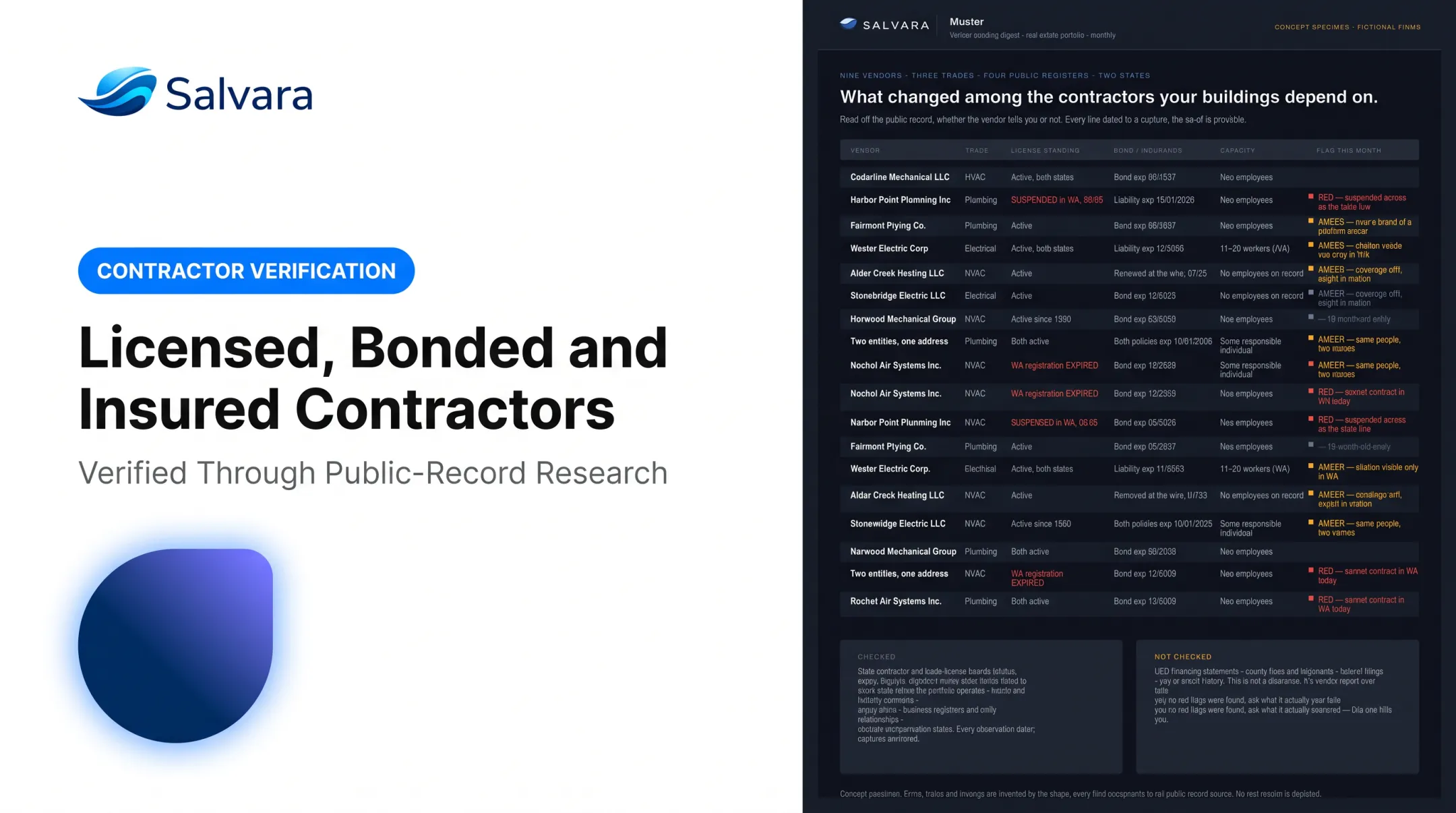
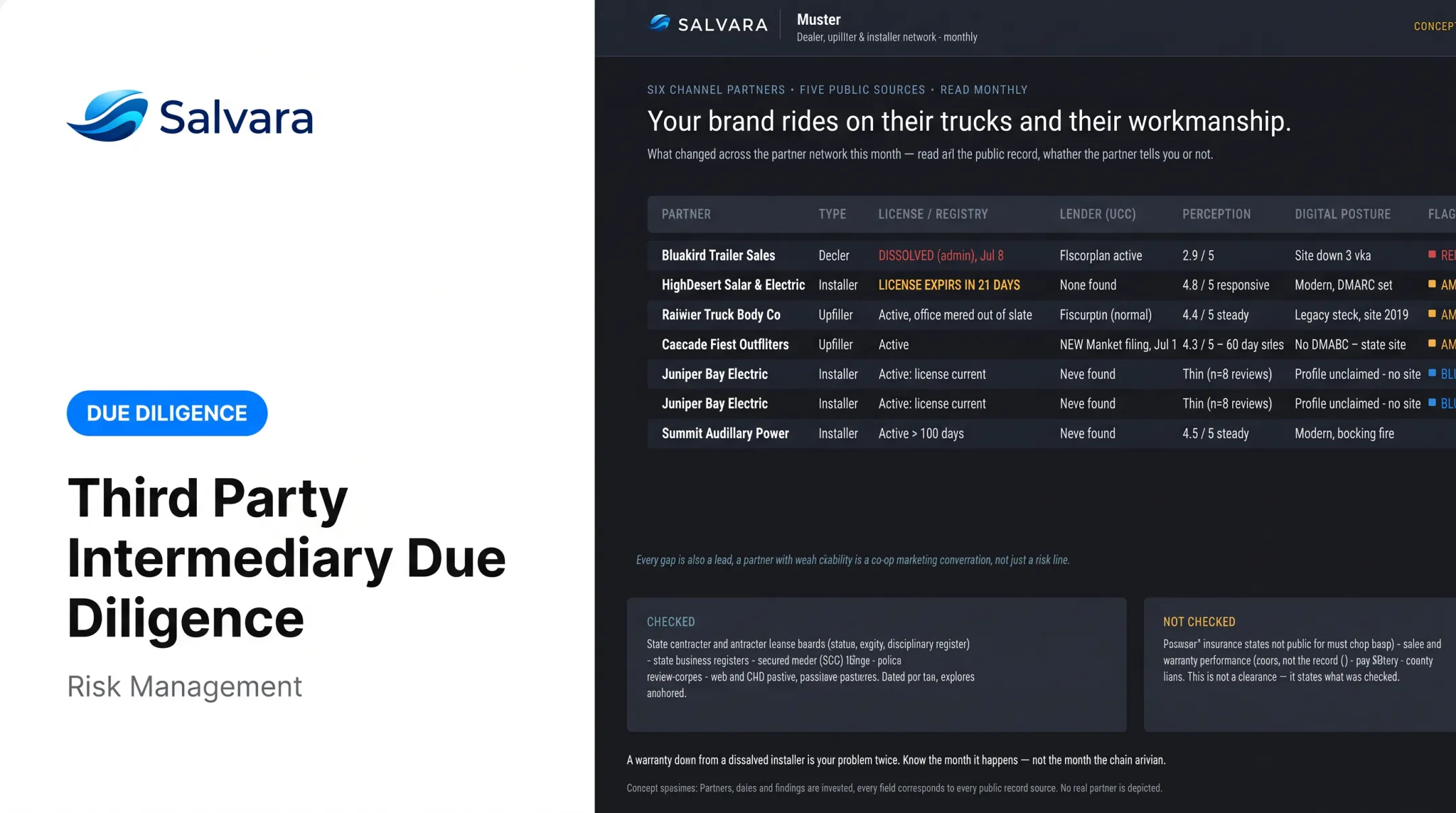
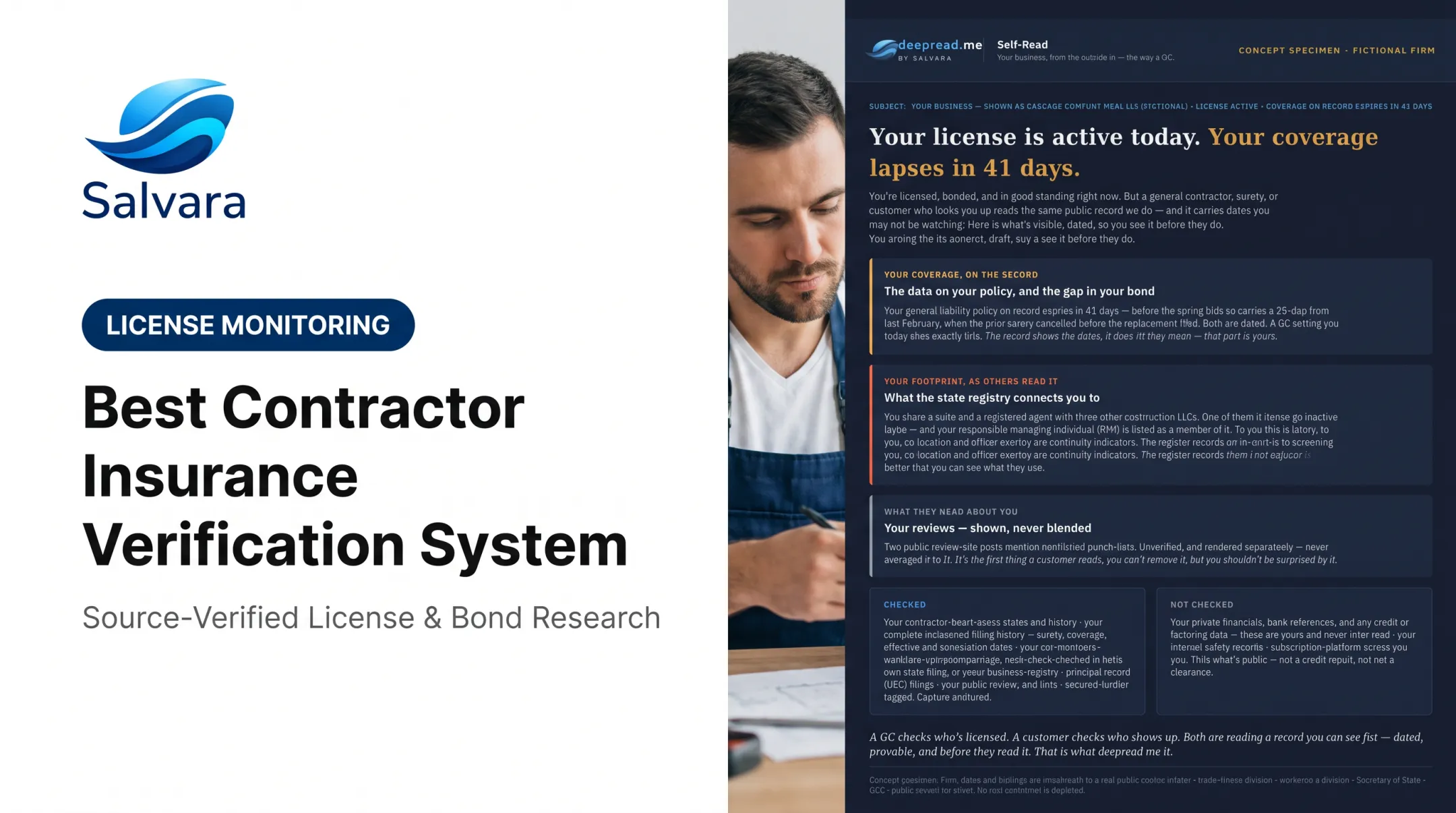
A research workflow like Salvara's pulls source-verified public-record findings into the file, with the source and capture date on each claim. It sits alongside a compliance management system rather than replacing one.
Monitor Time-Sensitive Items Continuously
License status, insurance expiration, worker certifications, permits, and contract milestones all have expiration dates. The process should trigger reminders before expiration and escalate anything overdue or disputed, instead of waiting for someone to notice during the next audit cycle.
Don't Stop at the Prime Contractor
Require prime contractors to disclose subcontractors, and define clearly whether the hiring organization or the prime owns each verification. Where site access or specialized work depends on an individual's credentials, track that person's qualifications directly, not just the company's status.
Status Rules Need Teeth
Define clear categories:
- Approved
- Conditionally approved
- Pending review
- Expired
- Suspended
- Rejected
Each status should dictate whether work, payment, or site access pauses. Build in an escalation path for disputes, missing information, and urgent work that can't wait for the normal review cycle.

How to Implement Ongoing Contractor Compliance Monitoring
A framework on paper doesn't run itself. Implementation means assigning real ownership and building a process that repeats without someone having to remember to run it.
Assign Ownership Across Functions
Procurement, risk, legal, safety, project management, and site operations each play a role:
- Procurement and risk set requirements
- A verification team or workflow checks records against sources
- Legal or risk approves exceptions
- Project management and site operations monitor active work and stop non-compliant contractors from starting or continuing
Spread the work, but name one accountable program owner. Without that, exceptions fall through the cracks between departments.
Build a Repeatable Lifecycle
A contractor's compliance status should move through defined stages:
- Intake and risk classification
- Prequalification and onboarding
- Active monitoring
- Incident or exception review
- Renewal, offboarding, and record retention
One-time contractors and high-risk trades may move through faster or require tighter checks, but the stages stay the same.
Use More Than One Monitoring Method
Documents alone miss too much. Combine:
- Registry checks and expiration reviews
- Site visits and inspections
- Progress reports and milestone reviews
- Invoice validation
- Safety observations and incident reviews
- Tenant or end-user feedback where relevant
Match frequency to risk. A high-access electrical sub working in occupied space warrants more frequent checks than a quarterly landscaping vendor.
Manage Exceptions Deliberately
When something doesn't check out, work the exception in order:
- Document the issue and identify the affected work or location
- Notify the responsible party and set a resolution deadline
- Record the final decision
Depending on severity, that might mean suspending work, restricting access, requiring corrective action, or granting conditional approval with documented controls.
Audit the Program Itself
Periodically sample contractor files and verification outcomes to catch stale records, inconsistent decisions, or requirements that no longer match the actual work being done.
A documented example from OSHA shows what sustained oversight looks like in practice. At Chicago's Rush University Transformation Project, Rush and its contractor joint venture ran weekly site safety tours starting in 2009 as part of an OSHA Strategic Partnership.
Those tours identified and addressed more than 150 hazards, many corrected the same day they were found. The site's recordable injury rate dropped from 24.1 in 2007 to 1.7 in 2011.
OSHA presents this as an observed result alongside recurring oversight, not proof that tours alone caused the decline. It is still a clear picture of what consistent, repeated checking looks like on a live site.
Technology, Evidence, and Performance Measurement
How you track compliance matters almost as much as what you track.
Comparing Your Options
| Method | Strength | Weakness |
|---|---|---|
| Manual/paper files | Full control over review | No automatic renewal alerts |
| Shared spreadsheets | Low cost, easy to start | Breaks down at volume; still relies on submitted data |
| Contractor portals | Centralizes submissions | Displaying a document isn't the same as verifying it |
| Specialized platforms | Automated alerts, audit trails | Can create false confidence if source data is outdated |
Automation speeds up the process, but it doesn't fix bad inputs. A dashboard showing green based on a contractor-submitted certificate is only as reliable as that certificate's accuracy on the day it was collected.
What a Trustworthy Evidence Record Looks Like
Every verification should capture:
- The specific requirement checked
- The source used
- The capture date
- Who or what workflow performed the review
- The result and any unresolved limitations
- A link to supporting documentation
This is the principle Salvara builds around: every claim carries its source and capture date, findings that are computed are labeled as such, and the system states plainly what was checked and what wasn't. That distinction — between a verified finding and an unsupported assertion — matters most when a file gets pulled up months later during a dispute or audit.
Metrics Worth Tracking
Rather than chasing an invented industry benchmark, measure your own program against itself over time:
- Pre-work approval rate
- Percentage of current licenses and insurance records
- Number and age of open exceptions
- Time to resolve deficiencies
- Monitoring completion by location
- Onboarding time
- Contractor incident or performance trends
No credible national benchmark exists for document-compliance rates or approval turnaround. Track trends in your own contractor population instead of borrowing someone else's number.
Conclusion
Contractor compliance monitoring is a continuous discipline. Paperwork accurate today can be stale by next quarter.
Start simple before you add more names to your contractor list:
- Inventory your current contractor requirements
- Identify where the biggest gaps sit
- Assign a single accountable owner
- Verify records against authoritative sources
- Put a documented renewal and escalation workflow in place
Frequently Asked Questions
What does contractor compliance mean?
Contractor compliance means meeting the licensing, insurance, safety, contractual, and regulatory requirements tied to a specific scope of work. Requirements vary by trade, project, and state or local jurisdiction—there is no single universal checklist.
What is a contractor compliance monitoring framework?
A monitoring framework is the policies, owners, verification steps, check frequency, status rules, escalation paths, and records that keep contractor compliance current after onboarding—not only at vendor setup.
What are examples of contractor compliance monitoring?
Common examples include license and insurance verification, credential renewals, safety-document reviews, site inspections, incident reviews, subcontractor checks, and invoice or milestone validation.
What are some good contractor compliance platforms?
Skip generic “best of” lists. Match the tool to your contractor volume, risk level, number of locations, integrations, source-verification strength, alert reliability, and audit-trail depth.
How often should contractor compliance be monitored?
Base frequency on risk, document expiration dates, work scope, regulatory rules, and site access. Check time-sensitive items such as licenses and insurance continuously, or before every new assignment.
What should be in a contractor compliance monitoring checklist?
Cover contractor identity, license and insurance status, safety docs, worker credentials, subcontractor disclosure, project-specific requirements, verification evidence, expiration dates, exceptions, and approval or escalation actions.