
Here's the problem: these are three separate protections, not one credential. A license proves authorization. A bond guarantees specific obligations. Insurance covers specified risks under a policy. None of them substitutes for the other two, and a contractor can hold all three while still leaving you exposed.
This guide is for property owners, landlords, general contractors, real estate professionals, and anyone managing outside contractors. We'll define each term, explain what it does and doesn't protect, and walk through a verification process you can actually repeat, because requirements shift by state, county, trade, and project type.
Key Takeaways
- A license proves authorization for defined work; a bond guarantees specific obligations; insurance covers specified risks. They're not interchangeable.
- Requirements vary by state, county, city, trade, and project size. Confirm current rules with the licensing authority.
- The phrase "licensed, bonded and insured" is a marketing claim until you verify identity, status, expiration dates, and coverage details.
- Businesses managing multiple contractors need ongoing vendor-risk monitoring, such as Muster, not a one-time paperwork check.
What Does Licensed, Bonded and Insured Mean?
Licensed: What a Contractor License Demonstrates
A contractor license is issued by a state or local authority and tied to a business, an individual qualifier, a trade classification, or a specific scope of work. It's not a universal pass to perform any construction task. Licensing typically involves some combination of:
- Trade examinations and documented experience
- Business registration and permit requirements
- Financial requirements, such as a bond or minimum net worth
- Ongoing code-compliance obligations Requirements differ by jurisdiction and trade, so always confirm which apply where the work is happening. California, for example, raised its handyperson exemption threshold to $1,000 effective January 1, 2025, but only if the person hires no workers and the job needs no permit. Above that, or if conditions aren't met, a license may still be required. CSLB's 2024 announcement spells out the specifics. What a license does not prove: quality of work, financial strength, active insurance, or authorization for every type of project. It confirms one thing: the contractor cleared a specific regulatory bar for a specific scope.
Bonded: What a Contractor Bond Guarantees
A surety bond is a three-party arrangement:
- Principal - the contractor whose obligation is guaranteed
- Obligee - the party the bond protects (often the licensing board or project owner)
- Surety - the company that issues the financial guarantee According to NASBP's guide to surety bonds, a contractor license bond is different from project-specific bonds:
- License bonds guarantee compliance with licensing statute obligations
- Bid bonds cover losses if a winning bidder won't sign the contract or furnish required bonds
- Performance bonds address contractor default on the project
- Payment bonds protect subcontractors and suppliers owed for labor or materials A bid bond does not guarantee construction will happen. A license bond does not promise project completion. Each bond protects against a narrowly defined obligation, limited by its wording, dollar amount, and named obligee. If a claim is paid, the contractor is often on the hook to reimburse the surety afterward. The bond isn't free insurance for the contractor, either.
Insured: What Contractor Insurance Covers
Contractor insurance usually includes:
- General liability - covers specified third-party bodily injury and property damage
- Workers' compensation - covers employees' occupational injuries (state requirements vary)
- Commercial auto - covers business vehicle liability
- Trade-specific or pollution coverage - relevant for certain specialties Insurance and bonding solve different problems. Insurance transfers a covered risk to the insurer. A bond guarantees an obligation; it doesn't act as blanket protection for every possible loss. Here's what many property owners miss: California's own consumer notice on general liability states that CGL is not intended to cover the contractor's own work. CSLB's guidance on commercial general liability makes this explicit. If a contractor botches a bathroom remodel, liability insurance isn't necessarily what pays to redo it. Coverage always depends on policy terms, exclusions, limits, deductibles, named insureds, and effective dates, not a contractor's verbal assurance. A certificate of insurance only summarizes what's in force at the moment it was issued.
Why Should You Hire a Licensed, Bonded and Insured Contractor?
Hiring a licensed, bonded, and insured contractor lowers your legal and financial exposure when work goes wrong. Each credential covers a different slice of that risk:
- Licensing creates a checkable regulatory status: the contractor is accountable to a board, knows permitting for their trade, and is authorized for a defined category of work
- Insurance can reduce exposure to covered incidents such as a worker injured on-site, third-party property damage, or a vehicle accident—exclusions and policy limits still apply
- Bonding offers a path for eligible claims involving defined misconduct, licensing noncompliance, nonpayment, or failure to perform; rights depend on the bond language and amount
The enforcement reality: California's licensing board opened 20,092 complaints against licensed and unlicensed contractors in 2025. Its fraud investigation team ran 28 sting operations and participated in 396 sweep days, closing 2,770 cases with 869 resulting in administrative or criminal action, according to the 2025 CSLB Accomplishments and Activities Report.

Those numbers are not a fraud rate. They show why you should verify documents instead of trusting advertising.
A One-Time Repair vs. a Multi-Site Vendor Relationship
A homeowner hiring someone for a single bathroom repair faces a different risk profile than a general contractor managing a bench of subcontractors across multiple active jobs.
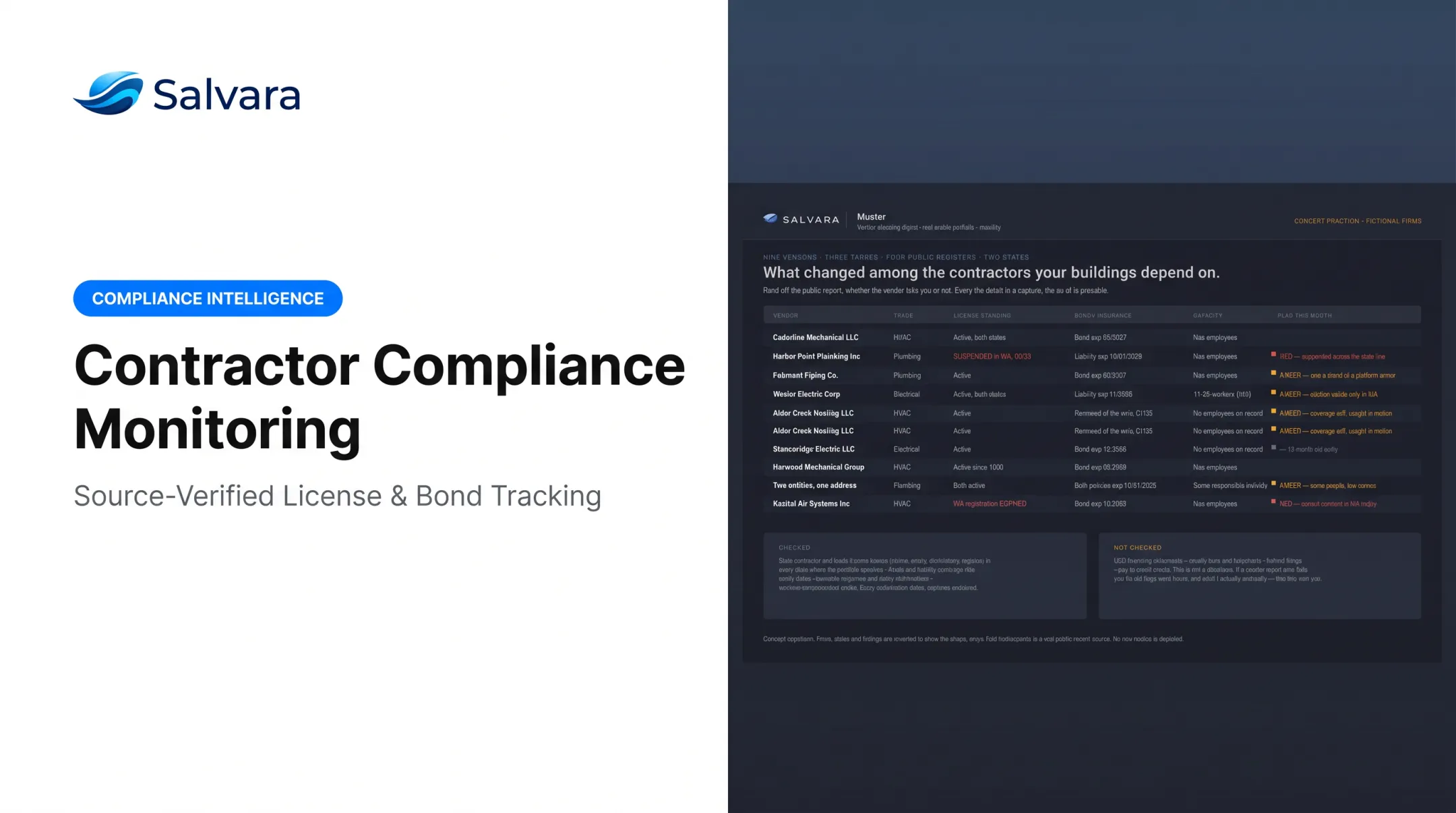
Consider a mechanical subcontractor under GC review before an award. A counterparty check shows an active license and a current bond, but the bond only became current after a 26-day gap. General-liability coverage on file expires in 41 days, before the project is expected to finish. An active license alone caught none of that.
For a one-time repair, a single verification pass before signing may be enough. For a multi-site operator or a GC managing dozens of subs, verification needs to be a repeatable, ongoing process, not a one-time paperwork exercise.
How to Verify a Contractor's License, Bond and Insurance
Start With the Correct Identity and Scope
Collect the exact legal business name, DBA if applicable, license number, trade classification, and the jurisdictions where work will occur. Then confirm the proposed work actually falls within that license's classification and limitations. Checking that some license exists isn't the same as checking that the right license exists for this job.
Check the License Through Official Sources
Search the relevant state, county, or municipal licensing database directly. Don't rely on a contractor's self-reported status.
| Jurisdiction | Official Lookup | What to Verify |
|---|---|---|
| California | CSLB Check a License | Status, classifications, disciplinary history, bond and insurance disclosures |
| Florida | DBPR License Search | Name or license number, relevant construction category |
| Texas | TDLR Search/Verify | Trade-specific registry (electrical, HVAC, etc.) |
| South Carolina | LLR Contractor Lookup | General/mechanical license separate from residential builder license |
Compare the official record against the proposal, contract, invoice, and website. Mismatched names, numbers, addresses, or corporate entities are a flag to resolve before signing anything.
Verify the Bond Directly
Request the core bond details in writing:
- Bond number and bond type
- Penal sum and effective dates
- Surety name and obligee
Then confirm the bond with the licensing authority or the surety itself—not through the contractor's marketing material.
NASBP recommends a two-step check: confirm the surety is authorized to write bonds in that state, then confirm the surety actually issued this specific bond. The NASBP guidance on verifying bonds notes that a state insurance department can confirm whether a surety is licensed there.
Verify Insurance Documentation
Request a current certificate of insurance and check:
- Named insured and insurer
- Policy numbers and types
- Effective and expiration dates
- Coverage limits
- Additional-insured or certificate-holder requirements
A certificate of insurance is evidence of stated coverage at the moment it was issued. It is not the policy itself and doesn't guarantee the policy hasn't changed since. A 2023 construction-law analysis from Koley Jessen on certificates of insurance calls a COI a "snapshot," not a binding document. When coverage is material to a contract, confirm terms with the insurer or broker directly.
Make Verification Repeatable
A documented checklist per contractor, with renewal reminders for licenses, bonds, and certificates, turns a one-off check into a repeatable process. For a handful of vendors, a spreadsheet may be enough.
Larger rosters outgrow manual tracking quickly—lapses show up between annual reviews. Salvara's Muster service is built for that gap: ongoing, source-verified monitoring of contractor credentials across every state where a vendor operates.
What it organizes for follow-up:
- Public-record and open-web findings with source links and capture dates
- Clear separation of computed findings vs. unsupported assertions
- Monthly flags on license standing, bond status, and insurance expiry
Salvara supports research workflows and documentation. It does not replace the licensing authority, insurer, surety, or legal counsel. Formal credential verification still runs through those channels.

Common Red Flags and Ongoing Monitoring Practices
Watch for these warning signs during onboarding or renewal:
- An expired or inactive license
- A license classification that doesn't match the proposed work
- A bond tied to a different legal entity than the one signing the contract
- An insurance certificate with coverage gaps or near-term expiration
- Inconsistent business names across documents
- Documents that can't be verified through official sources
- Pressure to skip verification or start work immediately
The FTC's guidance on home repair scams describes contractors who show up after a storm, push for an immediate decision, and request cash or unusual financing. These behaviors are warning signs, not proof of fraud, but they're reasons to slow down.
Pressure tactics are only one category of risk. Registry and entity problems can look fine on a basic license check and still hide gaps.
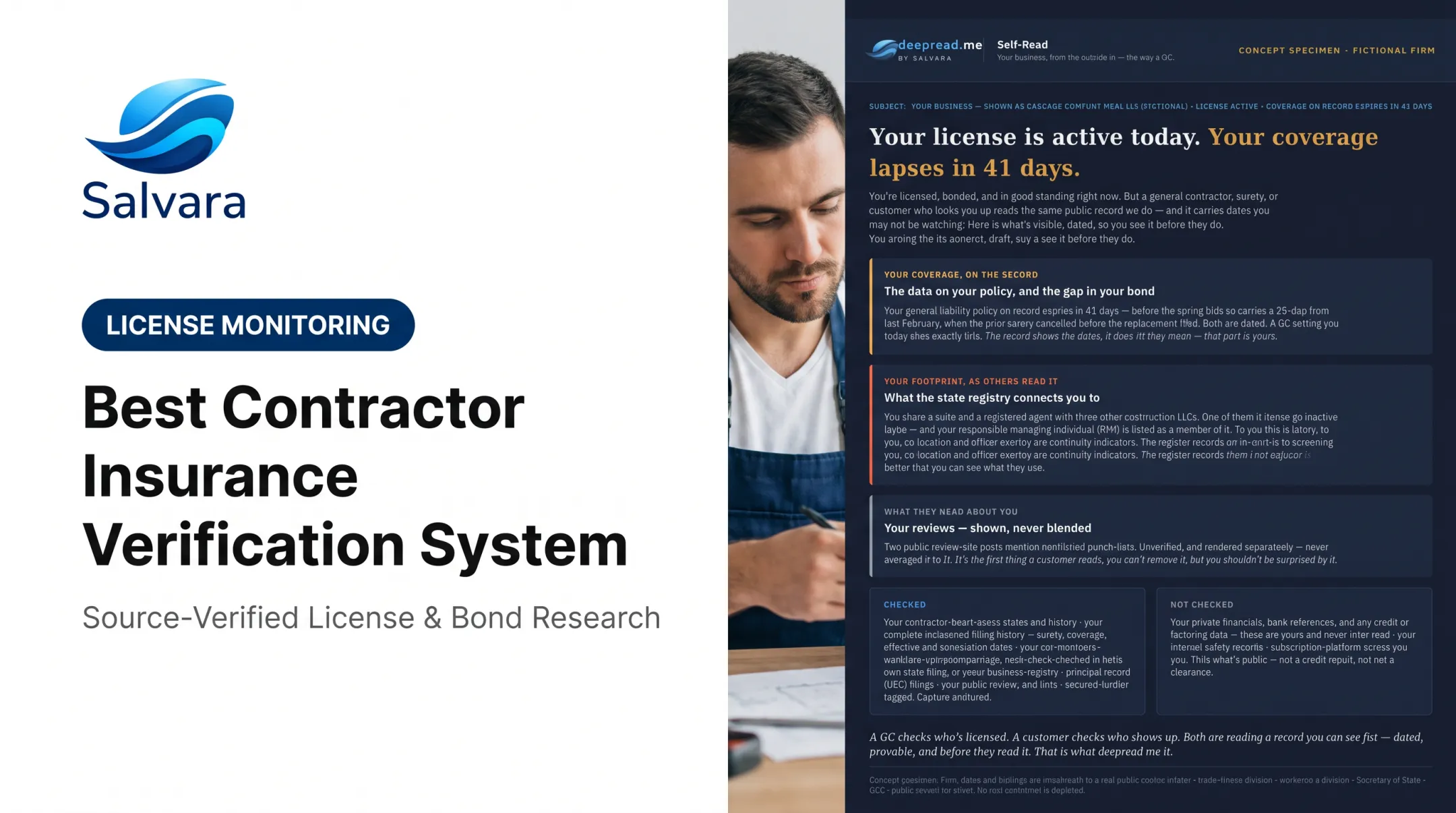
In one multi-trade subcontractor review, the firm's record linked it to three co-located construction entities. One of those entities went inactive after its bond lapsed.
The previous surety on the active bond had cancelled coverage just 26 days before a replacement bond was filed. None of that showed up in a simple "is the license active" check.

When to recheck credentials:
- At license, bond, and insurance renewal dates
- Before any major project begins
- After an ownership change at the contractor's business
- Whenever a contractor adds a new trade or service area
Landlords, general contractors, real estate professionals, and multi-site operators all face the same issue: a document that was accurate six months ago may not be accurate today.
Frequently Asked Questions
Why does a contractor need to be bonded?
Many states and local authorities require bonding to guarantee defined legal, licensing, payment, or performance obligations. A license bond is not the same as general liability insurance, and it doesn't cover every possible loss on a project.
How much does a contractor's license bond cost in California?
California requires a $25,000 bond amount for an active license, effective since January 1, 2023. That's the bond's face value, not the premium you'll pay. Get a current quote from a licensed surety provider, since premiums depend on underwriting and individual circumstances.
How much work can you do without a contractor license in South Carolina?
South Carolina's general and mechanical contractor license is required once total construction cost exceeds $10,000, per S.C. Code § 40-11-30 as amended in 2023. Residential builders are licensed separately under their own rules. Confirm your specific category with South Carolina's LLR before starting work.