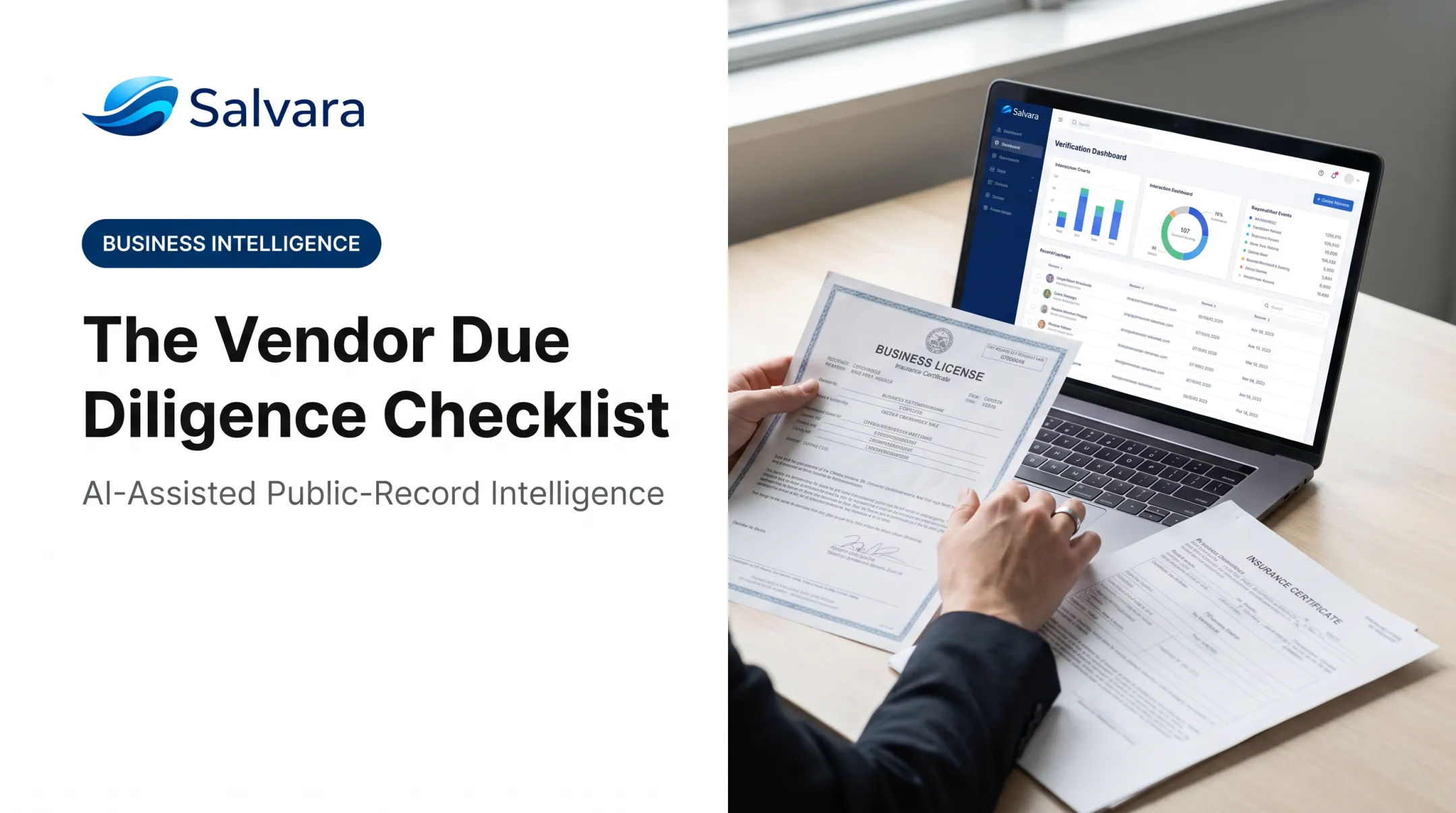

Why does this matter? Hidden ownership structures, sanctions exposure, fraud, regulatory violations, and reputational risk don't always show up in a basic search. A contractor with a lapsed bond that nobody rechecked, the kind of gap Muster is built to flag. A logistics company sharing an address with a revoked carrier. A vendor whose stated business doesn't match its transaction patterns. These gaps are exactly what EDD is designed to catch.
This checklist covers what to collect, where to verify it, how to interpret contradictions, and how to document a defensible decision. One caveat worth stating upfront: open-web research alone is never conclusive proof. It's a starting point for judgment, not a replacement for it.
Key Takeaways
- Opaque ownership, PEP or sanctions exposure, unusual transactions, and adverse media are the signals that should trigger EDD.
- A complete review covers identity, ownership, business activity, legal history, reputation, and ongoing monitoring.
- Every finding needs a source, a capture date, and documented analyst interpretation.
- Decisions should land on a risk-based outcome, not a simple pass or fail.
What You Need to Check in Enhanced Due Diligence
Before collecting a single document, define four things: who you're reviewing, why the relationship exists, how much risk it carries, and when you need a decision. The depth of your review should match the potential exposure, not a generic template.
FFIEC's guidance describes EDD as the additional information collected when a relationship poses heightened risk, with institutions expected to define in advance what triggers that extra step and what it requires (FFIEC BSA/AML manual). Organizations outside banking can use the same trigger-and-scope model.
Tools and Evidence Required
A thorough EDD file pulls from several categories of evidence:
- Identity records: legal name, aliases, incorporation and licensing documents, registered addresses
- Ownership information: beneficial owners, directors, organizational charts
- Financial evidence: transaction documents, financial statements, source-of-funds records where lawfully obtainable
- Legal and regulatory history: litigation records, enforcement actions, sanctions and watchlist results
- Reputational signals: relevant media coverage, regulatory filings
Separate what the subject tells you from what you independently verify. For every piece of evidence, record the source, the publication or filing date, your retrieval date, the relevant jurisdiction, and any limitations on what that source actually proves.
Not all sources carry equal weight. Federal and state registries, court records, corporate filings, licensing boards, and sanctions lists should outweigh anonymous posts, unverified directories, or claims repeated across multiple sites with no primary source behind them.
Strong source hierarchy only helps if you already know who is in scope and how sensitive data will be handled.
Preconditions and Setup
Define your scope before you start collecting: individuals, the company, beneficial owners, directors, key employees, subsidiaries, agents, intermediaries, and material counterparties. Scope creep wastes time; scope gaps miss risk.
Before handling personal or sensitive information, establish:
- Access controls — who can view collected records
- Retention limits — how long you keep sensitive data
- Secure handling — how data moves and where it's stored
Research the specific federal and state obligations that apply to your intended use. Tools built for public-record research, such as Salvara's evidence-gathering workflow, can structure license filings, bond records, permits, and published reviews into a usable file.
Human review and compliance judgment still decide what the evidence means. No research platform replaces that responsibility.
Methods to Conduct Enhanced Due Diligence
No single database or search answers every question. Treat these three methods as complementary, and corroborate any conclusion that could change your decision.
Method 1: Verify Identity, Registration, and Beneficial Ownership
Confirm the subject exists, operates under its stated identity, and has a consistent ownership and control structure.
What to check:
- State business registries and federal filings
- Professional licensing records and company disclosures
- Organizational charts and formation documents
- Appropriate identity documents
Step by step:
- Confirm legal names, aliases, registration status, addresses, and stated business activities across authoritative sources
- Trace ownership through subsidiaries, parent entities, trusts, nominees, and intermediaries to the actual people in control
- Compare the subject's disclosures against registry records and flag contradictions before proceeding
State registries don't always collect ownership data. California's business registry explicitly does not, and Delaware's own FAQ warns that a name-search result doesn't establish a company's current status.
Separately, FinCEN's 2026 rule exempts U.S.-created entities from Corporate Transparency Act beneficial ownership reporting, so don't ask a domestic LLC to produce a filing it isn't required to make (FinCEN BOI FAQs).
A documented ownership trail earns its keep here. Salvara's ownership and control research examines shared back-offices, common lenders, and quiet acquisitions behind a counterparty: connections a single registry search won't surface.
In one counterparty specimen, a state registry showed a trucking company sharing an address with four other logistics entities, one of which had revoked operating authority. That's not proof of wrongdoing, but it's a thread worth pulling before signing anything.

Pros and cons:
- Pros: Strong for confirming formal identity and structure
- Cons: Public records can be incomplete, outdated, inconsistent across states, or unavailable for private arrangements
Method 2: Screen Risk, Reputation, and Relationships
Identify sanctions exposure, PEP connections, enforcement activity, criminal or civil concerns, corruption indicators, adverse media, and relationships that change the risk picture.
What to check:
- Current US and relevant international sanctions lists
- Regulatory enforcement databases and court records
- Reputable news sources
- Relationship mapping across subsidiaries and intermediaries
Step by step:
- Search the subject, aliases, owners, directors, and key intermediaries using consistent identifiers to cut down on false matches
- Classify each result by source quality, date, jurisdiction, finding, resolution status, and relevance to the relationship
- Escalate material matches for corroboration rather than treating a name match or headline as proof
Sanctions exposure extends past names on a list. OFAC's 50 Percent Rule blocks an entity if blocked persons own at least 50% of it in aggregate, even through indirect ownership (OFAC FAQ 401). A clean name search doesn't rule that out.
PEP status and adverse media require the same discipline. Federal banking regulators and FinCEN have stated that a PEP connection doesn't automatically mean elevated risk (interagency PEP statement). With adverse media, you still have to examine the underlying allegation, whether it's resolved, and whether it's even the same person.

Pros and cons:
- Pros: Can reveal risks a questionnaire would never surface
- Cons: Demands careful identity matching, context assessment, and human judgment; a name match isn't a conclusion
Method 3: Validate Business Purpose, Funds, and Ongoing Activity
Test whether the counterparty's stated business model, finances, and expected activity actually make commercial sense.
What to check:
- Contracts, invoices, and financial statements
- Lawfully available banking evidence
- Expected transaction profiles
- Licensing records
Step by step:
- Document the purpose of the relationship — expected services, payment flows, geographies, transaction types, anticipated volume
- Compare the declared profile against available financial and operational evidence, noting unexplained complexity
- Define controls: additional approvals, payment restrictions, enhanced monitoring, or a scheduled reassessment
Paper trails and reality sometimes diverge. One counterparty read uncovered a mechanical contractor whose previous surety bond was cancelled 26 days before the replacement filed, and whose insurance expired before the project finished. An active license, by itself, doesn't guarantee coverage through completion.

Pros and cons:
- Pros: Ties findings to actual financial exposure
- Cons: Private financial information can be hard to obtain lawfully; collect only what's proportionate to the risk
How to Interpret EDD Results
A search result is not automatically a risk conclusion. Before you act on anything, weigh:
- Source reliability and corroboration
- Identity match strength and relevance
- Recency and seriousness of the finding
- The subject's own explanation
| Category | What it looks like | Action |
|---|---|---|
| Normal/Acceptable | Consistent identity and ownership, credible business purpose, explainable finances, no unresolved screening concerns | Document the rationale and approve |
| Minor Issues | Outdated registry details, spelling variations, incomplete documents, low-relevance media | Document, clarify, set a remediation deadline |
| Out-of-Spec | Unresolved ownership, credible sanctions matches, unexplained funds, deceptive documentation | Pause, escalate, or decline |
Decision framework:
- Approve
- Approve with controls
- Pause pending evidence
- Escalate to legal or compliance leadership
- Decline
If findings suggest activity that might trigger a regulatory reporting obligation, route it to a specialist rather than handling it informally. SAR requirements are sector-specific and should not be assumed to apply universally.
Your audit trail should capture:
- Scope, sources, and search dates
- Findings, reasoning, and unresolved limitations
- Reviewers, final decision, and any controls applied
- Trigger for the next review
Teams often skip this under deadline pressure, yet it is exactly what gets scrutinized later if the relationship goes wrong. Salvara attaches a source and capture date to every claim so a finding can be checked months later or handed to legal counsel without reconstruction work.
Common Errors and Best Practices
Most flawed EDD conclusions trace back to a handful of repeatable mistakes:
- Relying on a single database as if it were comprehensive
- Accepting self-reported information without independent verification
- Confusing a name match with a confirmed match
- Using outdated records without checking current status
- Copying adverse media coverage without assessing context or resolution
Unsupported AI summaries, scraped data, anonymous allegations, and duplicated articles should never be presented as verified findings. Require source links, capture dates, confidence language, and a human reviewer on anything that influences a decision.
FinCEN's own deepfake fraud alert describes AI-generated identity documents circulating in fraud schemes — a reminder that "it looked official" isn't a verification standard.
Practical safeguards:
- Collect only the information necessary for the identified risk
- Restrict access to sensitive records
- Avoid assumptions based on nationality or location alone
- Follow applicable US privacy and reporting requirements for your sector
EDD is not a one-time exercise. Refresh it on a schedule, and also when something changes: new ownership, new litigation, sanctions updates, major transaction shifts, acquisitions, or leadership turnover. A review from 18 months ago doesn't reflect today's risk.
Conclusion
Effective EDD rests on interdependent steps:
- Risk scoping
- Independent verification
- Ownership analysis
- Reputation and regulatory screening
- Business-activity review
- Documented judgment
- Ongoing monitoring
None of these steps work in isolation.
Complete certainty is rarely available. The practical standard is identifying material unknowns, making a defensible decision, and applying controls proportionate to the actual risk.
Platforms like Salvara help organize source-verified intelligence from public records, live systems, and open-web research. They preserve source dates, separate computed findings from unsupported claims, and state research boundaries clearly. The judgment part still belongs to you.
Frequently Asked Questions
What are enhanced due diligence checks?
EDD checks are deeper, risk-based investigations that go beyond basic customer due diligence. They typically cover ownership verification, sanctions and PEP screening, adverse media review, source of funds checks where appropriate, and ongoing monitoring.
What documents are required for enhanced due diligence?
Requirements vary by relationship and risk, but commonly include identity and incorporation records, ownership and control information, licenses, financial or transaction evidence, and supporting legal or regulatory records.
What is a CDD checklist?
A CDD checklist is the standard process for identifying and understanding a customer or counterparty. EDD adds deeper checks on top of CDD when specific risk indicators justify them.
When is enhanced due diligence required?
EDD is typically required for high-risk customers, opaque ownership, PEP or sanctions exposure, high-risk activities or jurisdictions, unusual transactions, or unexplained inconsistencies. Confirm which rules apply to your organization's activity.
What is the difference between CDD and EDD?
CDD is baseline identification and risk assessment. EDD is a proportionate escalation: deeper verification, corroboration, documentation, and monitoring applied to higher-risk relationships.
How often should enhanced due diligence be updated?
Frequency should follow risk: scheduled reviews combined with event-driven updates after ownership changes, new adverse information, sanctions developments, or material shifts in transaction activity.