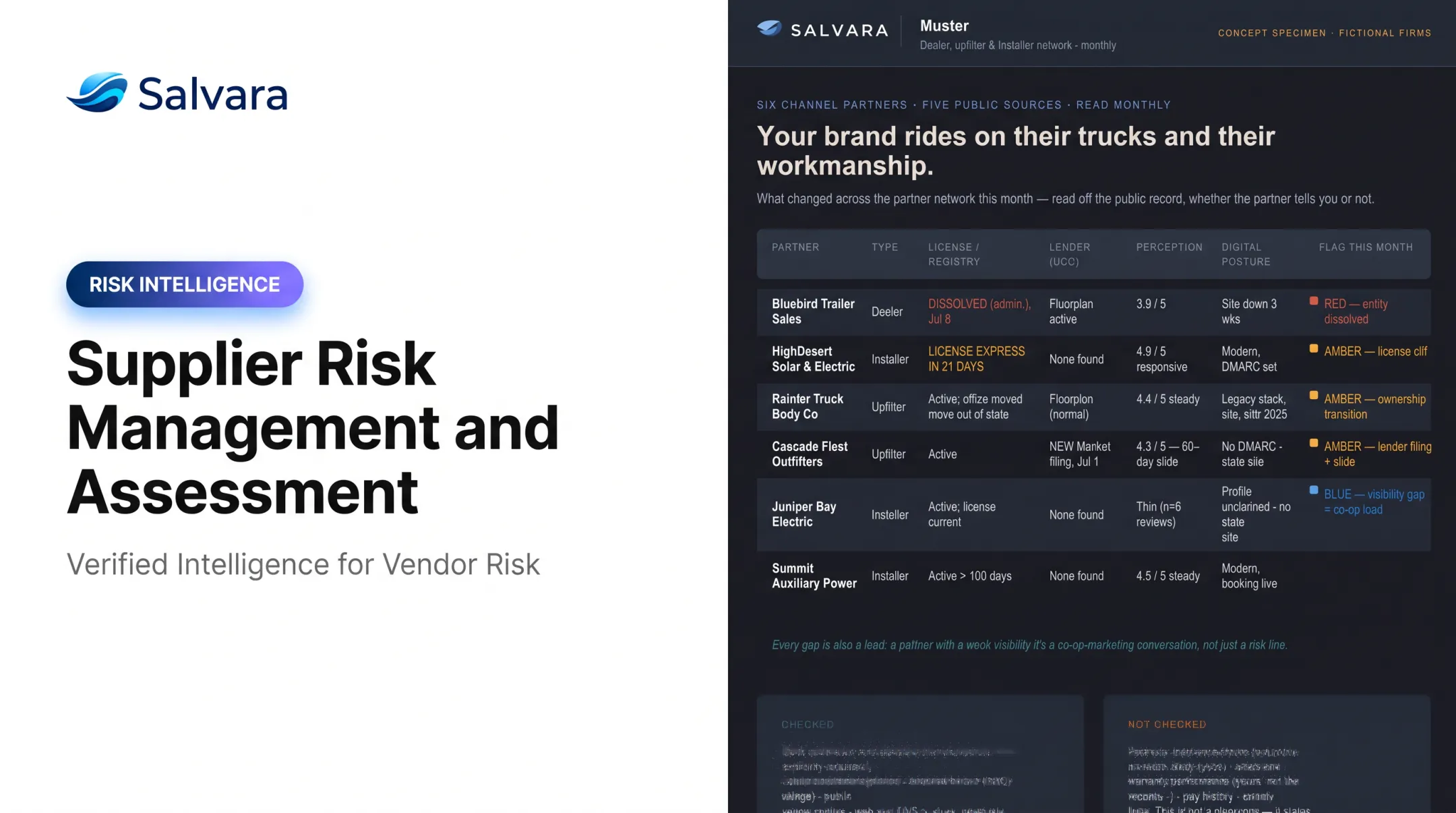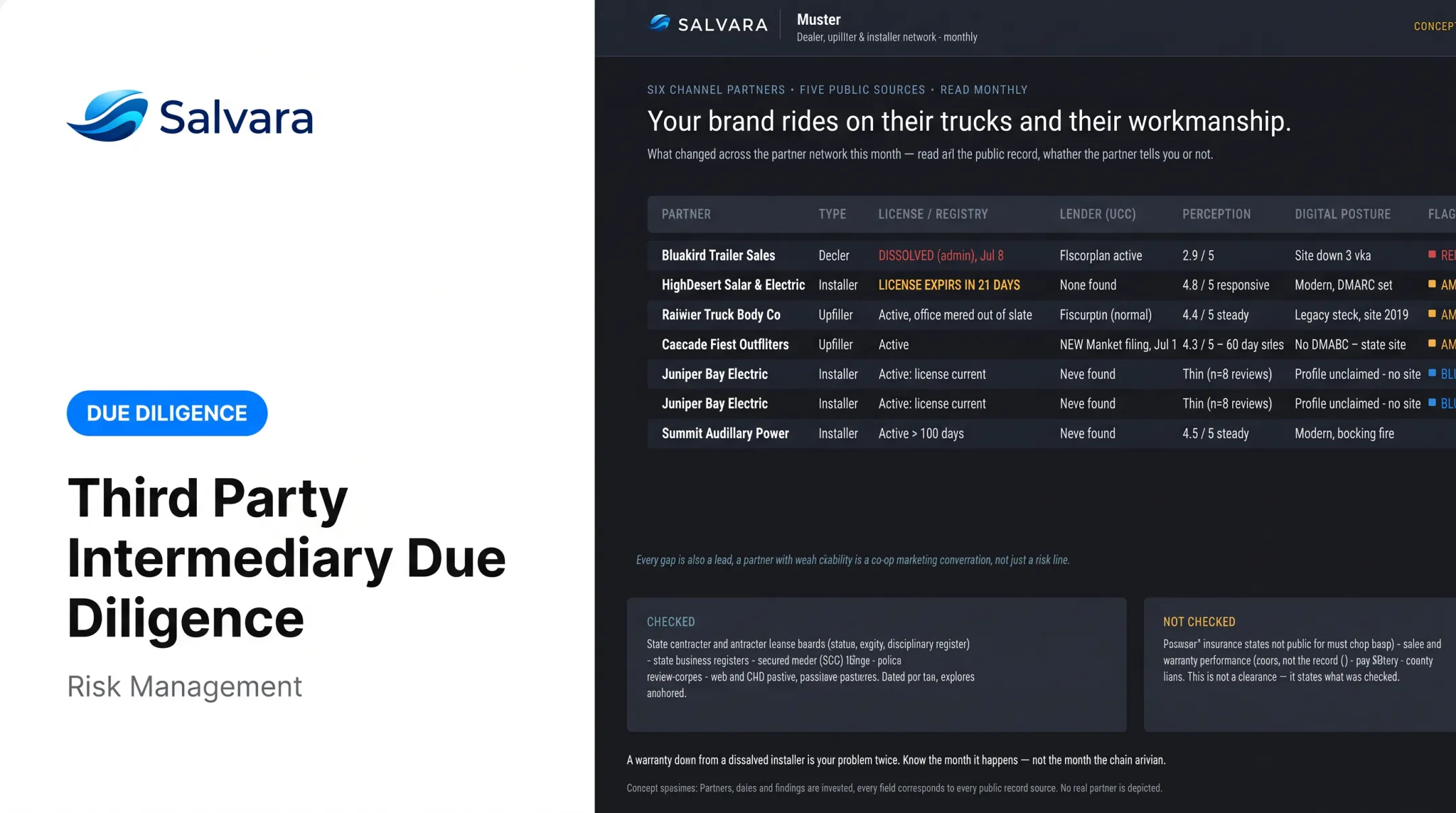

Many organizations still treat counterparty risk as a one-time checklist item. They verify documents at onboarding and move on. But counterparties change after approval — ownership shifts, licenses expire, cash flow tightens — which is why monitoring tools like Muster keep checking after onboarding.
Early verification combined with ongoing monitoring can prevent financial loss, operational disruption, compliance exposure, and reputational damage. This guide breaks down where counterparty risk comes from, what happens when it's ignored, and how to build a management framework that actually holds up over time.
Key Takeaways
- Counterparty risk hits customers, suppliers, contractors, partners, and landlords—not just banks.
- Weigh non-performance odds with exposure size, timing, and recoverability.
- Contracts, diversification, limits, collateral, and escalation steps cut downside.
- Pair financials with verifiable ownership, licensing, insurance, and legal records.
- Monitor material counterparties continuously; one onboarding check misses later changes.
Common Causes and Forms of Counterparty Risk
What Is Counterparty Risk?
Counterparty risk differs from general business risk. General business risk covers broad uncertainty across your operations. Counterparty risk is narrower: it attaches to a specific, identified party who might fail a specific obligation.
The Office of the Comptroller of the Currency defines counterparty risk as the chance that a party to an investment, credit, or trading transaction won't perform. The same logic applies outside banking: an unpaid invoice, a supplier that can't deliver, or a contractor that walks off a job.
Traditional borrower credit risk is one-sided: the lender is exposed, the borrower generally isn't. Counterparty credit risk in derivatives is bilateral: either side can lose money as the trade's value moves. Most commercial relationships sit closer to the one-sided model. If you're waiting on payment, delivery, or performance, you're the exposed party.
What Are the Main Forms of Counterparty Risk?
| Form | What It Means | Business Example |
|---|---|---|
| Pre-settlement (replacement) risk | A party fails before the deal completes, forcing you to replace it at a worse price | A supplier goes under mid-contract; you rebid at higher cost |
| Settlement risk | One side delivers cash, goods, or services but doesn't receive the agreed return | A cross-border payment clears late, leaving you exposed overnight |
| Default and performance risk | A party simply doesn't do what it agreed to do | Unpaid invoices, failed deliveries, expired contractor insurance |
Settlement risk gets overlooked most often. Solvency is not the issue; timing is. You can deliver cash, goods, or services and still be exposed until the return leg clears. Cross-jurisdiction transactions with different banking hours or clearing systems make that gap worse.
What Conditions Make Counterparty Risk More Likely?
Financial red flags:
- Excessive leverage or weak cash flow
- Adverse credit signals or downgrades
- Heavy concentration in one customer or supplier
- Unclear or shifting ownership structure
Non-financial triggers:
- Regulatory action or license expiration
- Insurance gaps or coverage lapses
- Unresolved litigation or sanctions concerns
- Cyber incidents or sudden management changes
How Does Exposure Differ by Transaction Type?
Exposure depends on more than deal size. Key drivers include:
- Legal entity on the contract
- Contract value, maturity, and payment terms
- Collateral and netting rights
- Time to recover or switch providers
A bank deposit does not carry the same exposure as trade credit with a small supplier. Recovery mechanisms, timelines, and legal remedies differ. Always trace exposure to the legal entity that signed the contract, not the parent brand on the letterhead.
Why Are Unrated or Opaque Counterparties Hard to Assess?
Private companies, family-owned businesses, and smaller contractors often lack public ratings or complete financial disclosures. That doesn't mean you skip the assessment — it means you widen the evidence base.
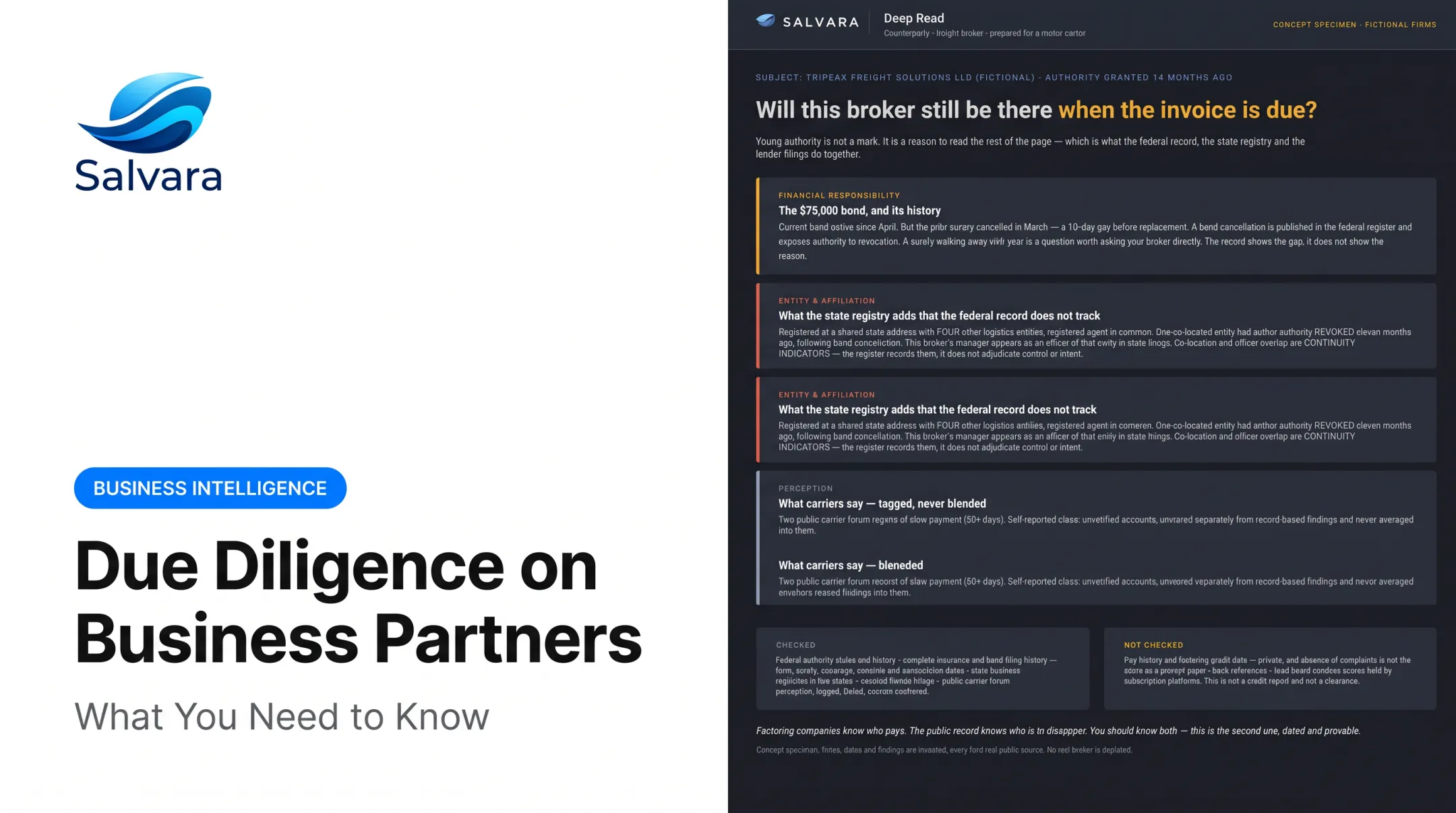
Salvara's Deepread approach examines corporate structure, ownership continuity, affiliations, financial responsibility, and channel presence from public filings, license registries, and the open web, rather than self-reported financials alone. When information is missing, the gap is recorded as an open question, not treated as clearance.

What Happens If Counterparty Risk Is Ignored
Ignoring counterparty risk creates direct and indirect costs.
Direct costs include:
- Lost deposits and replacement expenses
- Delayed projects and supply interruptions
- Uncollectible receivables, legal fees, and write-offs
Indirect costs include:
- Employee disruption and missed contractual obligations
- Regulatory scrutiny
- Reputational damage that outlasts the original loss
At the extreme end, the scale is hard to miss. When Archegos Capital Management collapsed in March 2021, banks including Credit Suisse and Nomura absorbed roughly $10 billion in losses, and more than $100 billion in shareholder value evaporated.
The lesson wasn't about derivatives modeling. Several institutions had concentrated, partly hidden exposure to one counterparty without realizing how connected they were.
Smaller businesses face a version of the same problem at a different scale. A Congressional Research Service report found about $1.6 billion in customer funds went missing after MF Global's bankruptcy (roughly $900 million domestic and $700 million tied to foreign-exchange customer accounts).

Segregation, reconciliation, and legal-entity clarity matter regardless of company size.
Warning Signs You're About to Experience Counterparty Problems
Treat these as triggers for review, not proof of wrongdoing:
- Deteriorating payment behavior — missed milestones, invoice disputes, unusual concession requests, or sudden changes to payment instructions.
- Structural changes — new ownership, leadership turnover, license or insurance lapses, or unresolved litigation.
- Worsening signals and concentration — negative customer feedback, operational capacity strain, or growing dependence on one counterparty.
In practice, a Deepread-style report on a mechanical subcontractor might show a $20,000 bond reinstated after a 26-day gap, with general-liability coverage set to expire in 41 days. Neither fact alone proves failure. Together, they're a pattern worth escalating before the next project milestone.
How to Prevent and Manage Counterparty Risk
Prevention works best as a repeatable lifecycle: identify the counterparty, assess the relationship, quantify exposure, control the contract, monitor changes, and respond when risk rises.

Identify and Classify Every Material Counterparty
Build a counterparty inventory that records:
- Legal entity and parent/affiliated group
- Relationship owner and transaction type
- Geography, exposure, and contract terms
- Criticality to your operations
Separate counterparties by type (financial institutions, customers, suppliers, contractors, partners) and set enhanced review criteria for the ones that matter most.
Perform Evidence-Based Due Diligence Before Approval
Verify public records, licenses, insurance, ownership relationships, litigation history, and operational track record before signing anything. Distinguish sourced facts from computed findings and unsupported claims.
Set documentation standards that include source links, capture dates, review scope, and unresolved gaps.
For organizations juggling large vendor or contractor rosters, a source-verified research approach like Salvara's speeds this checking and produces findings you can independently review later. That record matters when a dispute surfaces months after onboarding and someone asks, "What did we actually verify?"
Measure Exposure and Assess Likelihood of Loss
Banking risk models use three core concepts:
| Metric | Plain-Language Meaning |
|---|---|
| Probability of default (PD) | The estimated chance the counterparty fails to perform |
| Exposure at default (EAD) | The dollar amount actually at risk if default happens |
| Loss given default (LGD) | The share of that exposure you won't recover |
You don't need derivatives-grade models to use this thinking. A commercial version might simply track current receivables, advance payments, undelivered goods, replacement cost, and any collateral or insurance backing the deal. Aggregate exposure across subsidiaries and business units so separate teams don't unknowingly stack risk with the same counterparty.
Set Limits and Use Contractual Protections
Common protections include:
- Advance payments, deposits, or collateral
- Guarantees, insurance certificates, and performance bonds
- Termination rights, audit rights, and covenants
- Step-in or replacement provisions for critical relationships
Legal enforceability varies by contract type and jurisdiction. Material terms should always go through qualified counsel before you rely on them.
Diversify and Prepare for Failure
Reduce concentration by maintaining alternative suppliers, contractors, or banking relationships where practical. Build a documented response plan covering who can pause payments, freeze new exposure, invoke contractual rights, and escalate to legal or executive leadership.
Monitor, Test, and Improve the Framework
Set review frequencies based on criticality, with event-driven reviews after ownership changes, missed obligations, or financial deterioration.
A one-time check only captures a snapshot; it misses problems that appear later. Monthly monitoring catches a lapse while it is still happening. Salvara's Muster product follows this model, tracking license standing, bonds, insurance expiry, and entity relationships across contractor and vendor rosters.
Tips for Long-Term Prevention and Control
Prevention holds when the same controls run after onboarding, not only at kickoff. Build these habits into the operating rhythm:
- Routine monitoring: Reconcile exposure against contracts and invoices. Confirm licenses and insurance stay current. Log source dates so stale evidence is never treated as current fact.
- Training and standards: Train procurement, treasury, legal, and relationship owners on approval limits, evidence standards, escalation triggers, and fraud-resistant payment-change procedures.
- Documentation and technology: Keep a centralized counterparty register with an audit trail. Link every finding to its source and capture date, and state clearly what was and was not checked.
- Governance: Assign first-line ownership, independent oversight, and senior escalation paths. Review the policy on a set cadence and run a post-incident analysis after any breach or near miss.
Conclusion
Counterparty risk has identifiable drivers: financial weakness, concentration, incomplete due diligence, contract gaps, and unmonitored change. None of it is mysterious once you know where to look.
No organization eliminates every counterparty failure. But verified information, measured exposure, appropriate protections, diversification, and continuous monitoring together reduce surprises and the size of losses when something does go wrong.
Frequently Asked Questions
How do you manage counterparty risk?
Identify and classify counterparties, run evidence-based due diligence, measure exposure, set risk limits and contractual protections, diversify where practical, and monitor continuously with a documented response process for when problems surface.
What is counterparty risk management?
A coordinated process of assessing, controlling, monitoring, and responding to the risk that another party won't meet its obligations. It runs from onboarding checks through ongoing surveillance of the relationship.
What is counterparty risk?
The possibility that another party fails to pay, deliver, settle, or perform as agreed. Impact depends on exposure size, when the failure hits, and how recoverable losses are under the contract.
What are examples of counterparty risk?
A bank failing on a deposit, a derivatives partner defaulting mid-trade, a customer missing an invoice payment, a contractor without current insurance, or a cross-border settlement clearing late.
How do I check a supplier or customer before signing or extending credit?
Confirm the legal entity and its status with the state business registry, check any required licenses and insurance with the issuing authority, and search court records for litigation. For credit customers, ask for trade references and set a credit limit you can afford to lose.
What contract terms protect me if a counterparty doesn't pay?
Common protections include deposits or milestone payments, clear due dates with late-payment terms, the right to suspend work or deliveries, personal or parent-company guarantees, and termination rights. Enforceability varies by state and contract type, so have counsel review material terms.