
Introduction
A supplier goes dark for three weeks. A contractor's insurance lapses the week before a jobsite accident. A vendor holding customer data gets breached, and nobody finds out until a regulator calls.
These scenarios share one root cause: risks that existed long before the disruption, but weren't identified until it was too late.
Supplier risk management exists to close that gap. It helps organizations make informed sourcing and relationship decisions instead of reactive ones.
In Deloitte's 2022 survey of more than 50 US electric-power and renewable-sector executives, 86% reported increased operational costs as a significant supply-chain impact, with 64% citing project delays.
This article walks through a practical framework: defining the supplier risk universe, collecting and verifying evidence, scoring risk, assigning mitigation actions, and monitoring suppliers over the full supplier lifecycle.
Key Takeaways
- Supplier risk spans financial, operational, compliance, cybersecurity, reputational, concentration, continuity, and geopolitical exposure.
- Depth of review should scale with criticality, not just spend: a low-cost sole source can be your highest-risk vendor.
- A risk score is a decision aid, not a universal pass/fail number; thresholds reflect your own risk appetite.
- Every finding needs an owner, a deadline, an escalation trigger, and a review date — or it won't get fixed.
What Is Supplier Risk Management and Assessment?
Supplier risk management is the ongoing process of identifying, evaluating, mitigating, and monitoring risks tied to suppliers, contractors, vendors, and other external providers. It doesn't end once a contract is signed.
A supplier risk assessment is a point-in-time exercise that establishes a baseline. Supplier risk management is what happens after: updating that picture as conditions change and coordinating action when they do. Treating them as the same thing is a common mistake. Organizations run one assessment at onboarding and then assume the risk is "handled."
Supplier risk is broader than price and delivery performance. A supplier failure can disrupt operations, violate compliance obligations, expose customer data, damage your reputation, or hit revenue directly, often all at once.
Types of Supplier Risk to Watch
US banking regulators' interagency guidance on third-party relationships identifies financial condition, legal compliance, information security, operational resilience, and subcontractor dependency as core due-diligence dimensions. That framework is a useful starting point for any organization, not just banks.
Common categories to assess include:
- Financial — insolvency signals, weak liquidity, high leverage, declining margins, payment delays, customer concentration, inadequate insurance.
- Operational and continuity — capacity constraints, quality failures, single-site dependency, weak recovery plans, limited substitutability.
- Compliance and legal — expired licenses, regulatory violations, litigation, sanctions exposure, beneficial ownership concerns.
- Cybersecurity and privacy — data access scope, security governance gaps, incident history, subcontractor exposure.
- Reputational, ESG, and concentration — adverse media, labor or environmental complaints, over-reliance on a single customer or facility.
Which categories matter most depends entirely on what the supplier does and what it can touch: your data, your customers, your regulated processes.
How to Conduct a Supplier Risk Assessment: A Step-by-Step Process
A structured process keeps assessments consistent across suppliers and defensible later, if a decision is ever questioned.
- Define the scope. Identify the supplier, the services or products provided, locations, data or system access, annual spend, contractual importance, customer impact, and dependencies on its own sub-suppliers.
- Segment suppliers. Group them by business criticality, financial exposure, substitutability, concentration, regulatory sensitivity, and operational impact, before you go deep on any single one.
- Collect evidence. Request policies, licenses, insurance certificates, financial statements, business continuity plans, security documentation, performance records, ownership details, and references.
- Validate independently. Cross-check supplier-provided information against public filings, licensing or regulatory records, litigation and lien records, sanctions data, news, and reviews.
- Document each finding. with its source, capture date, evidence strength, affected risk category, business impact, and any unresolved conflicts.

Assessing Supplier-Provided and External Evidence
A current document isn't automatically a reliable one. Before trusting any piece of evidence, check that it is:
- Complete and internally consistent
- Tied to the actual contracting entity, not only a parent company
- Appropriate for the supplier's risk tier
A certificate of insurance naming the wrong entity is worse than no certificate at all: it creates false confidence.
An evidence-based research workflow helps here. Salvara, for example, organizes public records, open-web information, and live organizational data into findings that keep their source and capture date, instead of a single opaque conclusion. Your team still sets the supplier score; the workflow supplies a verifiable foundation for it.
Human review still matters most where it's hardest to automate: ambiguous findings, conflicting records, or decisions that could affect contract award, supplier termination, customer safety, or regulatory exposure.
What to Evaluate in a Supplier Risk Assessment
Once evidence is in hand, evaluation has to go deeper than a checklist.
Review these dimensions with evidence, not assumptions:
- Financial health: Balance sheets, income statements, cash-flow statements, credit reports, and payment behavior. S&P Global's methodology weighs cash sources against cash uses, liquidity cushion, and covenant exposure. Even a profitable supplier can default if liquidity runs short, so check customer concentration and restructuring signals against current industry benchmarks—not a universal ratio.
- Operational resilience: Capacity, quality results, on-time delivery, incident history, key-person dependency, and whether continuity plans have been tested, not only written.
- Compliance and legal exposure: Licenses, permits, insurance, regulatory history, sanctions screening, and beneficial ownership. FinCEN's current rule exempts most US domestic companies from beneficial ownership reporting, so a missing BOI filing from a US supplier is not, by itself, a red flag.
- Cybersecurity and privacy: Match depth to data and system access. A supplier handling customer PII needs a harder look at security governance, incident history, and assurance reports such as SOC 2 Type II or ISO/IEC 27001 than one with no system access.
- Reputational, ESG, and concentration risk: Adverse media, labor and environmental complaints, ownership ties, and reliance on a single customer or facility.
Matching Evaluation Depth to Supplier Criticality
Not every supplier needs the same scrutiny. The table below shows how review depth typically scales:
| Tier | Evidence required | Approval authority | Review frequency |
|---|---|---|---|
| Basic | Standard questionnaire, license check | Procurement | Annual |
| Enhanced | Financials, insurance, references, security questionnaire | Procurement + Finance/Legal | Semi-annual |
| Critical | Full financial analysis, continuity testing, on-site or audited evidence | Cross-functional committee | Quarterly or event-driven |
Spend alone does not set the tier. These suppliers often belong in critical review even when invoices are small:
- Single-source parts or service providers
- Vendors with system or data access
- Providers supporting a regulated process
Procurement, finance, legal, compliance, IT/security, and operations should each contribute evidence in their domain. No single function sees the full risk picture alone.
How Is a Supplier Risk Score Calculated?
A basic scoring model follows four steps:
- Identify relevant risk categories
- Rate likelihood and impact for each
- Apply category weights based on organizational priorities
- Combine the results into an overall rating
A transparent scale (low, moderate, high, critical) needs written definitions for each level, with examples of evidence that would move a supplier between them. Weighting should shift by supplier type: cybersecurity might dominate the score for a data processor, while continuity and capacity carry more weight for a sole-source manufacturer.

There's no universal cutoff that applies to every organization. CIPS's supplier risk framework describes assessing probability and severity against your own risk tolerance. It doesn't prescribe a fixed numerical scale, and neither should you. Calibrate thresholds against your own historical incidents, contractual obligations, and risk appetite.
Before trusting any score, test it:
- Is the underlying data current, or stale?
- Is any information missing or contradictory?
- Does the score rely too heavily on a single metric?
Always pair the number with a short narrative explaining why.
What Makes a Supplier Risk Score Actionable?
A score that doesn't trigger a response is just a number. Connect each rating to a defined action:
- Low: routine monitoring.
- Moderate: request additional evidence.
- High: senior approval, corrective action plan, or contract controls.
- Critical: alternate sourcing or suspension pending review.
"Unknown" is not the same as "low risk." Missing evidence on a critical supplier should trigger a data-quality flag or escalation, not a pass. Preserve an audit trail that records:
- Who reviewed the evidence
- When the score was calculated
- What changed since the last review
- Why the final decision was made
Mitigation, Monitoring, and Supplier Risk Management in Practice
Every material finding needs a mitigation plan, not just a note in a file. At minimum, document:
- Risk statement and potential business impact
- Action required, accountable owner, and due date
- Success measure and escalation trigger
- Contingency plan
Common mitigation options:
- Dual sourcing or qualified alternate suppliers
- Inventory or capacity buffers
- Contractual protections, audit rights, or stronger insurance requirements
- Remediation timelines with milestones
- Tighter access controls for data-handling suppliers
- Adjusted payment terms tied to performance
Once plans are in place, monitoring frequency should match supplier tier and risk type: scheduled reviews plus event-driven triggers such as financial deterioration, license expiry, adverse media, a security incident, or an ownership change.
This is where a one-time check fails. A vendor roster checked in January can look clean, then deteriorate by June: a license lapses, a lender files a UCC claim, or capacity shrinks.
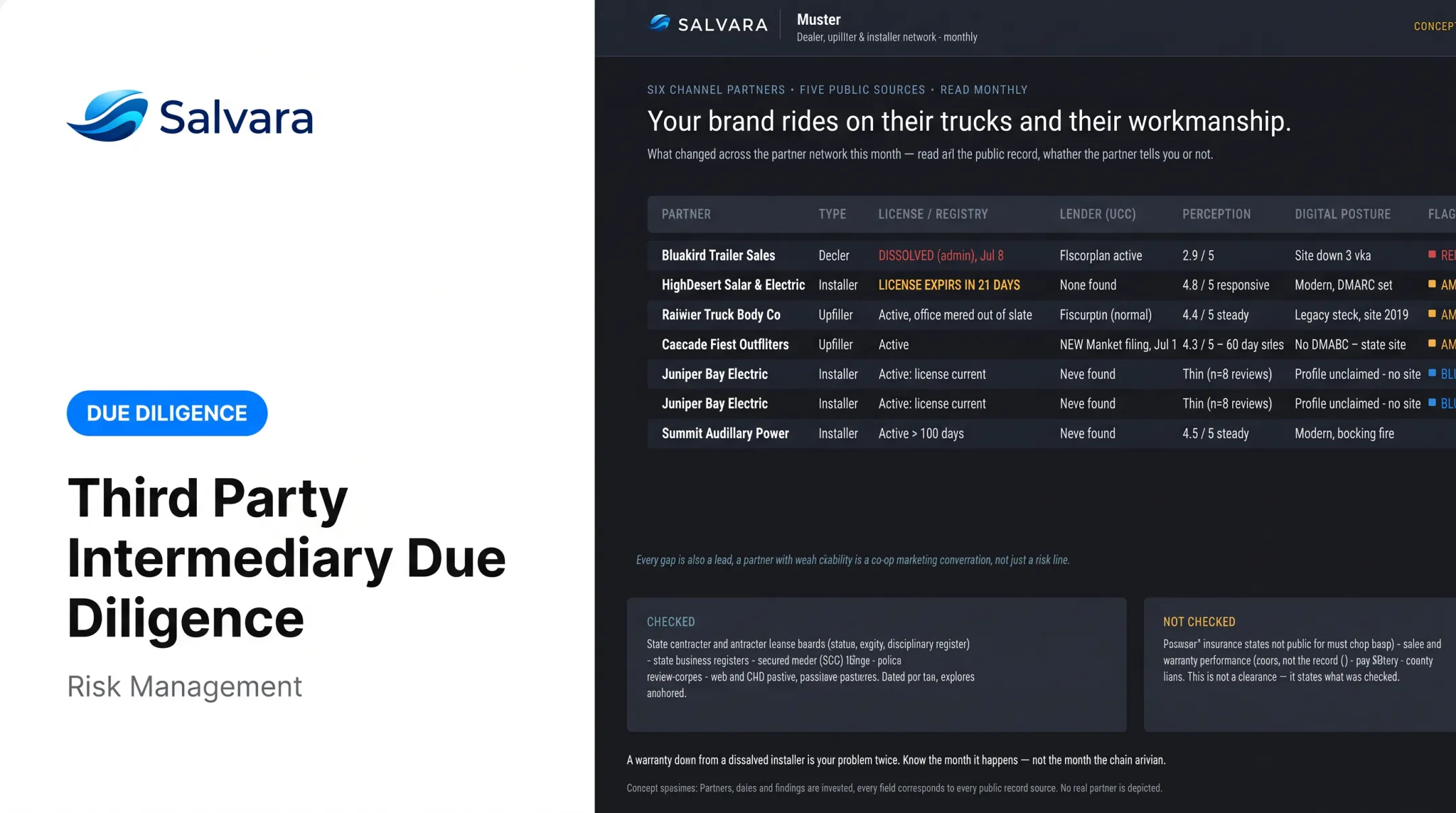
Monthly monitoring, like the approach Salvara's Muster service applies to contractor and supplier rosters, catches a lapse while it's happening instead of after a claim or missed delivery. In one internal example, a dashboard tracking six channel partners flagged an installer's license expiring in 21 days and an ownership transition in the same monthly cycle—either easy to miss in an annual review.
Useful KPIs include:
- Liquidity and profitability trends
- On-time delivery rate
- Defect or incoming-inspection failure rate
- Corrective-action closure time
- Insurance and license validity
- Concentration exposure
Source-verified, dated findings (with origin and capture date, not a vague "as of recently") help teams confirm external changes quickly during these reviews. Internal governance and human judgment still make the final call.
Supplier Risk Assessment Challenges and Best Practices
Most supplier risk programs fail because the work is fragmented, not because teams lack effort. Common challenges include:
- Supplier records scattered across procurement, finance, and legal systems
- Incomplete disclosures and stale documents
- Inconsistent scoring between business units
- Little to no visibility past tier-one suppliers
That visibility gap is where programs break down. McKinsey's December 2025 survey found 95% of organizations reported visibility into tier-one supplier risk, but only 42% into tier two or beyond. Most risk hides exactly where most organizations aren't looking.

Best practices worth adopting:
- Build a centralized evidence repository with standardized questionnaires
- Segment suppliers before deciding review depth
- Establish cross-functional governance across procurement, legal, IT, and operations
- Set review schedules proportionate to risk, not uniform across all vendors
Don't let an annual questionnaire become the entire program. Combine supplier engagement, independent evidence, performance data, and event-driven reassessment. Revisit your assessment criteria after incidents, near misses, supplier exits, or major market shifts. Let the framework change with what those events teach you.
Frequently Asked Questions
How do you perform a supplier financial risk assessment?
Review financial statements, credit and payment data, liquidity, profitability, leverage, and cash flow alongside qualitative context like customer concentration. Document the scoring rationale and attach mitigation actions for anything concerning.
How is a supplier risk score calculated?
Rate likelihood and impact across relevant risk categories, apply weights based on your priorities, and combine them into an overall rating calibrated against your own risk appetite. No universal score applies to every supplier or industry.
What are the key steps and evaluation criteria for selecting suppliers?
Define scope, identify risks, and collect validated evidence. Evaluate financial, operational, compliance, and security factors, then score the supplier, secure stakeholder approval, and build in contractual controls with ongoing monitoring.
What is an acceptable supplier risk score?
It depends on your risk appetite, the supplier's criticality, how easily they can be replaced, regulatory obligations, and the strength of available mitigation. No single number applies everywhere.
What KPIs should be used for supplier financial risk assessment?
Track liquidity, profitability, cash flow, leverage, credit rating changes, payment behavior, receivables aging, and customer concentration, benchmarked against relevant industry data where available.
What is SRM in an audit?
SRM stands for supplier relationship management. An audit of SRM typically reviews supplier selection, due diligence depth, risk classification accuracy, performance monitoring, issue remediation, and documentation practices.